

Revisiting 3C 279 jet morphology with space VLBI at 26 microarcsecond resolution
Teresa Toscano
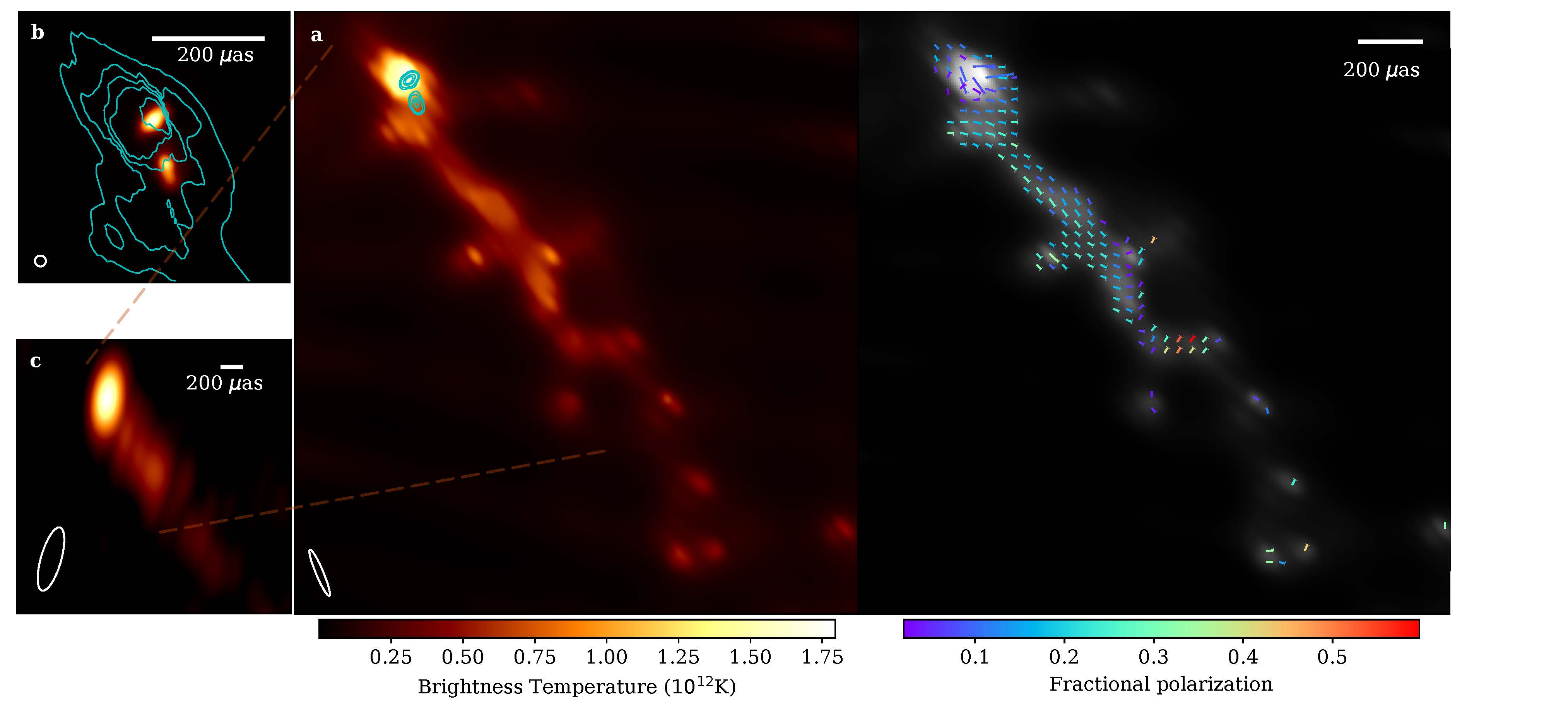
Building on earlier detections of filamentary structure in 3C 279 from 2014 RadioAstron data (Fuentes et al. 2023), the authors compare a new epoch in 15 January 2018 at 22 GHz with that earlier epoch, as well as with close-in-time 43 GHz data from the BEAM-ME program and 230 GHz data from the Event Horizon Telescope (EHT). While the 2014 epoch showed bright filamentary features interpreted as Kelvin-Helmholtz instability signatures, the 2018 epoch shows no clear trace of those filaments, a significantly lower integrated flux density (~10.2 Jy versus ~27 Jy in 2014), and a drop in fractional polarization (~5 % versus ~10 %). The authors carry out synthetic-data imaging tests to evaluate whether the absence of filaments is an observational effect (sparser uv-coverage, lower brightness) or intrinsic evolution. The tests suggest that even if filaments were present they cannot be recoverable under the 2018 observational characteristics.
Beyond morphology, the alignment of electric vector position angles with the jet axis supports a scenario in which the toroidal component of the magnetic field dominates on parsec scales, in agreement with a helical field geometry often invoked in jet-launching and collimation models. The measured brightness temperature of the core (1.6×10¹² K) lies close to the equipartition limit, from which the authors infer a magnetic field strength near 0.2 G. They further note that the 2018 observations occurred during the rising phase of a γ-ray flare, but find no clear contemporaneous
increase in radio flux, not finding a correlation between the high-energy and radio emission regions for this event.
Link to the paper:
A&A, 704 (2025) A225
Contact:
Teresa Toscano Domingo, Max Planck Institute for Radioastronomy, Bonn, Germany. Email: ttoscano@mpifr-bonn.mpg.de
José Luis Gómez Fernández, Instituto de Astrofísica de Andalucía, España. Email: jlgomez@iaa.es