

Was gamma-ray burst GRB 220627A gravitationally lensed or was it a rare "ultra-long" event?
James Leung
The time delay of the two pulses indicated that two lensed images of the afterglow separated by a few milliarcsec (the Einstein radius) should be visible if the gravitationally lensing hypothesis was correct: VLBI imaging provided the only way to reach this resolution to confirm the hypothesis. The VLBI arrays were triggered to observe the GRB as soon as it was detected by more compact arrays. However, the flux density of the source decayed much more quickly than anticipated, making the experiment lack the sensitive to lead to a conclusive outcome. This realisation only occurred more than 1 month after the data was taken due to the time it takes for it to be correlated. Real-time correlation would have led to a quicker turnaround and adjustment in the observing strategy that would have guaranteed the experiment's success. This experiment highlights the importance of this capability for next-generation VLBI arrays for time-domain science.
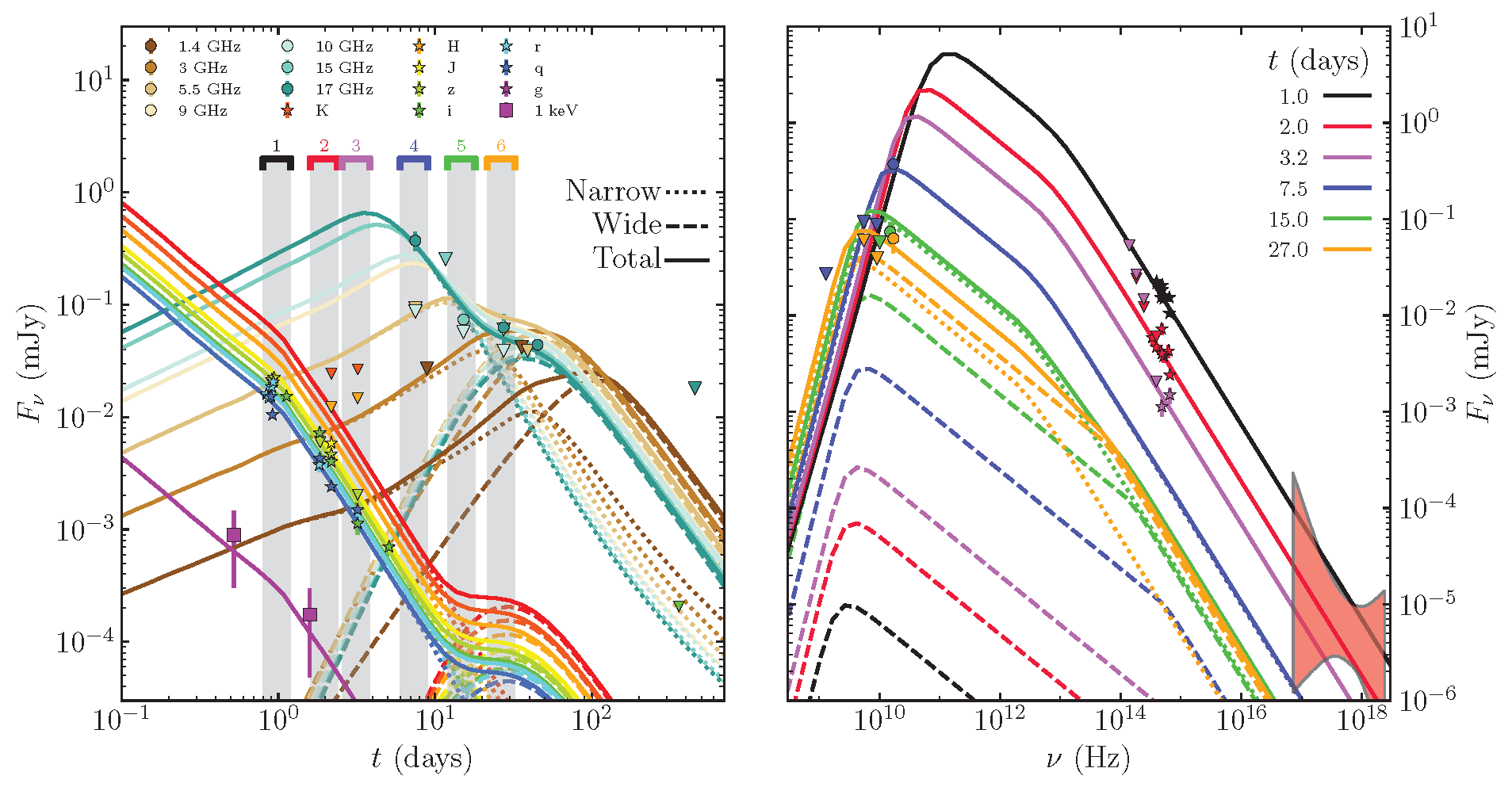
However, through alternative methods re-analysing the high-energy spectrum, our team was able to determine that this event was unlikely to be a gravitationally lensed GRB, and instead belongs to a rare subclass of events that last an unusually long time (~10min). It is currently difficult to explain how a central engine can power outflows for this long, and our radio observations reveal some clues. We observe in our radio light curves a steep decay followed by a shallower decline. One possible explanation for this is the presence of a slow, wide ejecta component in addition to a fast narrowly-collimated ejecta component ploughing into its immediate post-explosion environment. If the wide component is interpreted as a cocoon it may support the idea that blue supergiants could be viable progenitors that can power these ultra-long GRBs.
Link to the paper:
James K. Leung et al 2026 ApJ 996 22
Contact:
James Leung. Email: jamesk.leung@utoronto.ca