

Milliarcsecond-resolution radio-imaging survey of blazar candidates at 4 < z < 5.4
Máté Krezinger
However, to do this, the unambiguous classification of a source as blazar is required, which at high redshifts can be challenging. Relying on a single classification method might not be sufficient, as the different methods could disagree in some cases. A unified classification method combining multi-wavelength data—including optical, low- and high-resolution radio, and X-ray data—can be the key to obtain the most accurate classification of high-redshift radio quasars.
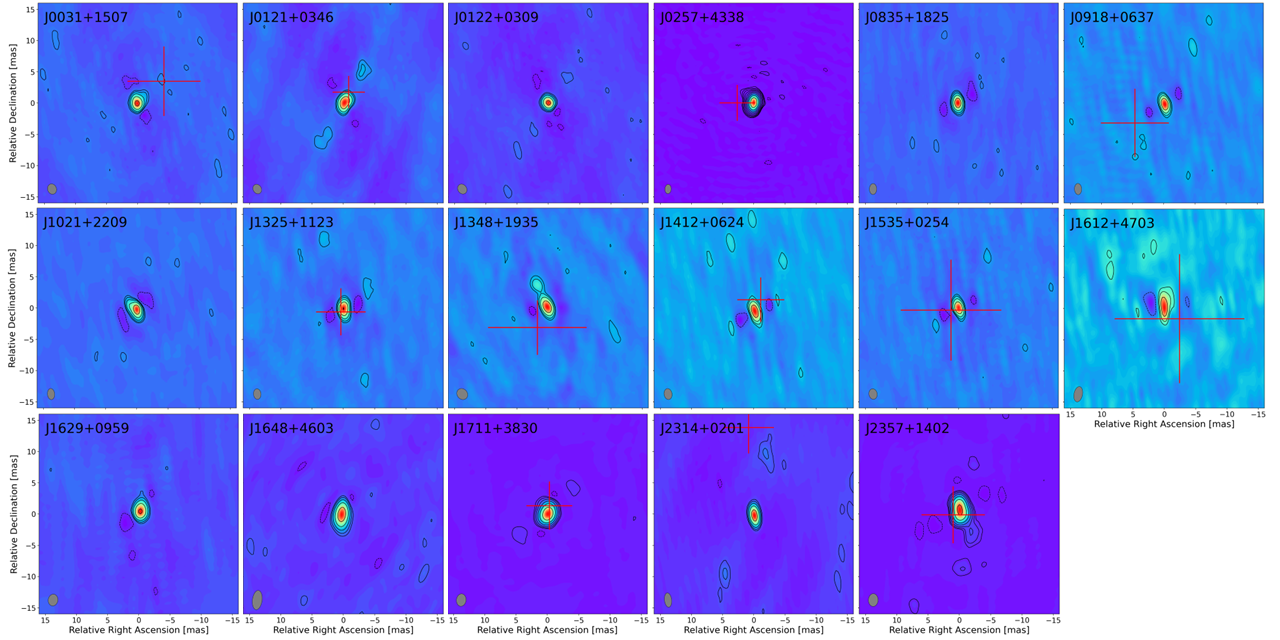
Figure 1: The naturally weighted EVN 5-GHz VLBI images of the target radio quasars. The lowest contours are drawn at ±3 times the image noise; the positive contours increase by a factor of 2. The grey ellipses are the beams and are representing the resolution of the array. The red crosses represent the Gaia optical positions (when available) and their size indicates the 3σ positional uncertainty.
We have carried out very long baseline interferometry (VLBI) follow-up observations of the CLASS (Cosmic Lens All Sky Survey) high-redshift blazar candidate sample conducted by Caccianiga et al. (2019). Our main goal was to support the previous X-ray classifications (Ighina et al. 2019) with the radio data. The 17 radio quasar, located at 4 < z < 5.36, were observed by the European VLBI Network (EVN) at 5-GHz in phase-referenced mode (EC062A–B and EC066A–B, PI: A. Caccianiga). Six of the 17 targets that were not yet observed by VLBI at any frequency, and two other targets were observed by VLBI at 5 GHz for the first time. The high-resolution 5-GHz radio maps are shown on Figure 1. We used the VLBI data to estimate the core brightness temperatures and assess the presence of Doppler boosting, while low-resolution radio flux density measurements from the literature helped us to draw a more complete picture about the source properties, such as the origin of the radio emission, the flux density variability, and the spectral indices. Precise Gaia DR3 optical astrometric positions were available for 12 targets, also assisting the constrains on the source classification.
Based on the collected multi-wavelength data, we proposed to classify the objects as either a blazar or a misaligned radio quasar, and then compared these classifications to the findings of Ighina et al. (2019). Figure 2. shows the studied quasars on the ã0X – Tb,5-GHz diagram. Both Tb from radio observations and ã0X from X-ray measurements are proxies of jet orientation, which we expect to correlate with each other. A significant fraction of these high-redshift radio-loud quasars are blazars, and mainly characterized by compact core structures. Overall, the VLBI and the X-ray classifications are in agreement. However, there were a few uncertain sources. These uncertainly classified objects could be at the border of the blazar classification and need additional data to confirm their true nature. Gathering multi-wavelength data for large samples is a challenging task, especially because simultaneous observations would be ideal. Even so, the combined approach presented here offers a valuable path forward and can be an important tool for future high-redshift source classification.
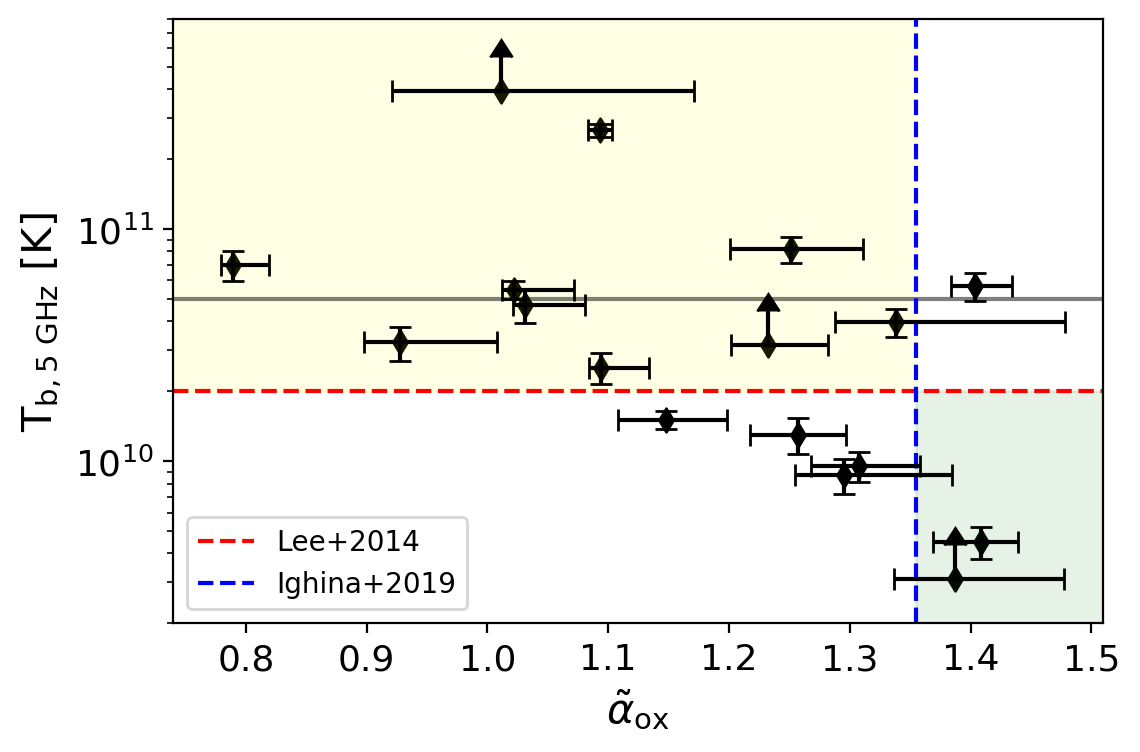
Figure 2: The ã0X – Tb,5-GHz diagnostic plot for the 17 high-redshift quasars studied in this paper. ã0X= 1.355 serves as the threshold (vertical blue dashed line) to separate the blazar and nonblazar populations (Ighina et al. 2019). The horizontal red dashed line represents the intrinsic brightness temperature at 5 GHz (Tb,int = 2 × 10¹⁰ K) taken from Lee (2014). The sources in the yellow shaded area are considered blazars. The green shaded area represents the locations of misaligned sources. The blazar classifications of sources falling in any of the two white regions are uncertain.
References:
Caccianiga et al. 2019, MNRAS, 484, 204
Ighina et al. 2019, MNRAS, 489, 2732
Lee 2014, JKAS, 47, 303
Link to the paper:
Krezinger et al., 2026, ApJS, Volume 282, 1, 21
Contact:
Máté Krezinger, HUN-REN CSFK, Hungary. Email: krezinger.mate@csfk.org