

Back from the dead: AT2019aalc as a candidate repeating tidal disruption event in an active galactic nucleus
Patrik Milán Veres
The family of nuclear transients including TDEs, nuclear supernovae, and changing-look AGN, has expanded rapidly in recent years. This progress is partly driven by follow-up campaigns aimed at identifying electromagnetic counterparts to high-energy neutrinos. The origin of the high-energy neutrino flux detected by the IceCube Observatory remains unresolved, although accretion flares in AGN have been proposed as a possible source (van Velzen et al. 2024). One such optical flare, AT2019aalc, was discovered by the Zwicky Transient Facility in 2019 in a known AGN and showed a re-brightening in 2023. We carried out a multi-wavelength campaign of this second optical flare, from radio to X-ray bands. The optical spectra reveal emission lines produced by the Bowen fluorescence mechanism, which typically occurs in UV-bright environments (e.g., Netzer et al. 1985) such as X-ray binaries and TDEs, and is not associated with standard AGN activity. These lines have been observed in only a handful of nuclear transients distinct from known TDEs, forming the class of Bowen fluorescence flares (BFFs; Trakhtenbrot et al. 2019). The spectroscopic properties of AT2019aalc are consistent with this classification.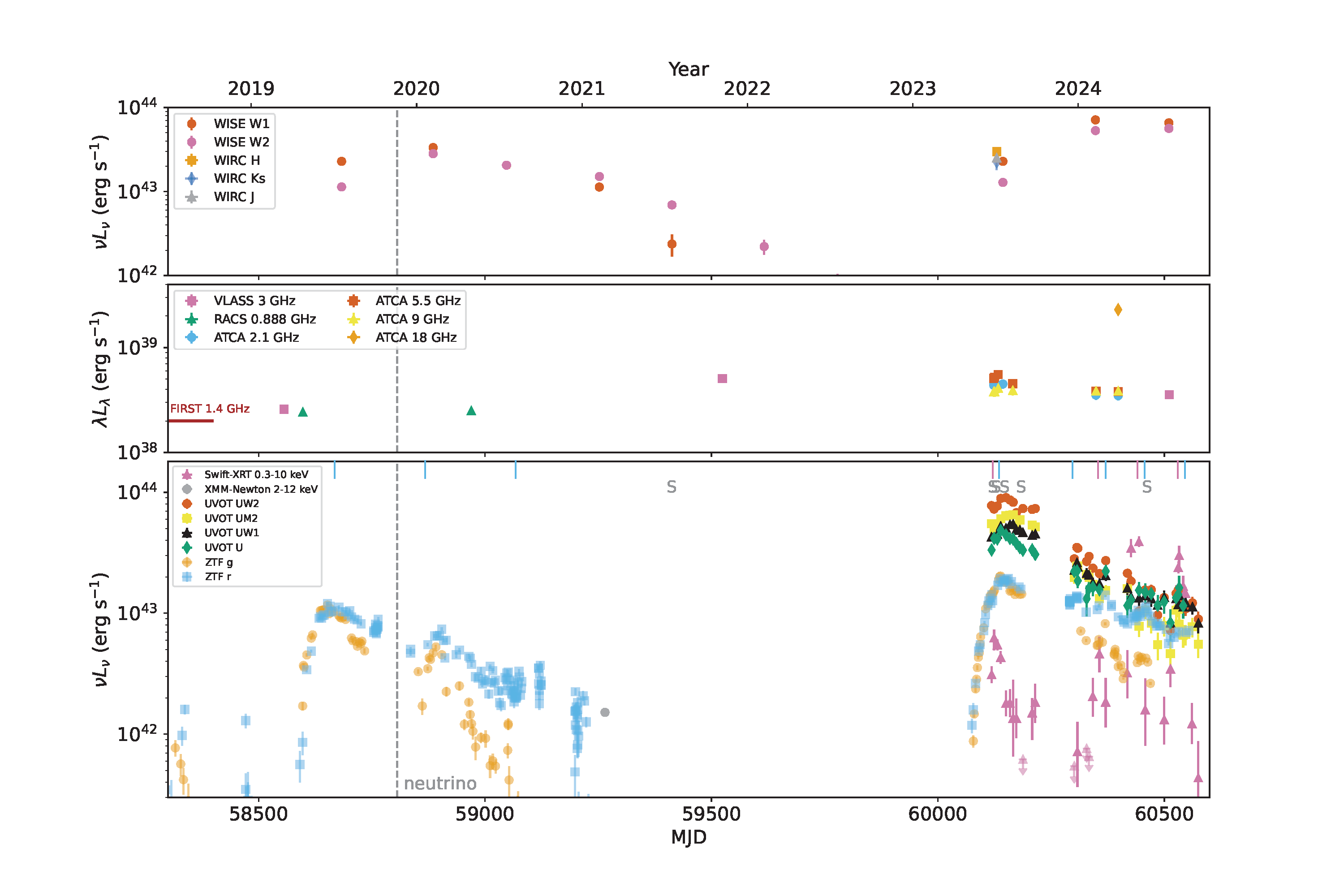
Figure: Multi-wavelength (bottom plot: X-ray and optical/UV, middle plot: multi-band radio and upper plot: IR) light curves of the Bowen fluorescence flare AT2019aalc. The short, purple vertical lines on the top of the bottom panel indicate the peak times of the soft X-ray flares while the blue ones represent the times of the main optical flare, and later the quasi-periodic bumps associated with disk precession.
The physical mechanism powering BFFs remains unclear, largely due to the small number (less than 10 to date) of known events. By compiling archival radio data, we find that most BFFs, including AT2019aalc, show delayed radio flares relative to their optical peaks. To investigate the origin of this emission, we performed VLBI observations of AT2019aalc with the EVN and the e-MERLIN and detected a compact source in the L-band. The inferred brightness temperature (~3 x 10^8 K) confirms a non-thermal origin, ruling out processes such as free–free emission. In addition, our multi-wavelength analysis disfavors advection-dominated accretion flows and magnetized coronal winds. The most plausible explanation is synchrotron emission from outflowing material triggered by enhanced accretion. This interpretation is consistent with the spectral turnover around 9 GHz seen in our ATCA monitoring, as high-frequency turnovers are commonly associated with newly ejected, synchrotron self-absorbed outflow components.
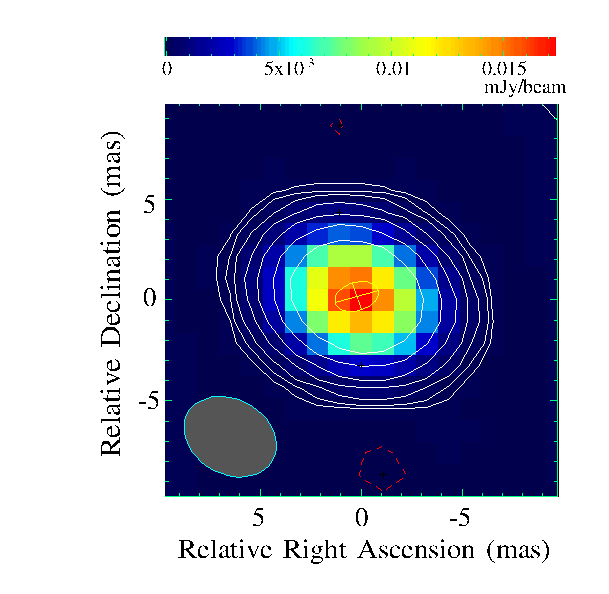
Figure: Naturally weighted 1.7 GHz EVN+e-MERLIN VLBI map of AT2019aalc created using Difmap. The brightness distribution is modeled with a single Gaussian modelfit component represented by the yellow ellipse.
The delayed radio flare in AT2019aalc is likely the outcome of a sudden increase in accretion. A key question is what drives this accretion episode. Given that AT2019aalc shows TDE-like features such as an infrared dust echo and soft X-ray emission, while occurring in a pre-existing AGN, we suggest it may represent a TDE within an AGN environment. In this scenario, the disrupted star interacts with the accretion disk, producing soft X-rays that are reprocessed into optical and infrared emission in the gas-rich and dusty AGN environment, while also powering the Bowen fluorescence in the broad-line region. Optical polarization measurements (Jordana-Mitjans et al. 2025) further support a precessing accretion disk due to the Lense-Thirring effect following the disrupted material-disk interaction.
A partial TDE scenario, in which a surviving stellar core returns for a second interaction with the disk, could explain the repeated flaring activity. Nevertheless, accretion disk instabilities remain another possible explanation for AT2019aalc (Śniegowska et al. 2025). It is also possible that BFFs are not a uniform class: a recently identified coincidence between the BFF AT2023zgo and a gravitational-wave superevent (Bommireddy et al. 2026) suggests that, in some cases, these events may be linked to merging stellar-mass black holes embedded in AGN disks. In such systems, an accretion flare could trigger the response in the broad-line region, producing the observed Bowen lines. Overall, Bowen fluorescence appears to trace extreme accretion episodes in AGN that differ from standard activity, and are potentially linked to multi-messenger phenomena. Further high-resolution radio observations of AT2019aalc and other BFFs will be essential to constrain the physical mechanisms driving these rare and intriguing transients.
References:
Bommireddy et al. 2026, eprint arXiv:2603.04342 accepted by A&A
Jordana-Mitjans et al. 2025, Astronomy & Astrophysics, Volume 704, id.A250, 19 pp.
Netzer et al. 1985, Astrophysical Journal, Part 1 (ISSN 0004-637X), vol. 299, Dec. 15, 1985, p. 752-762.
Śniegowska et al. 2025, The Astrophysical Journal, Volume 989, Issue 2, id.173, 27 pp.
Trakhtenbrot et al. 2019, Nature Astronomy, Volume 3, p. 242-250
van Velzen et al. 2024, Monthly Notices of the Royal Astronomical Society, Volume 529, Issue 3, pp.2559-2576
Link to the paper:
A&A, 706, A324 (2026)
Contact:
Patrik Milán Veres, Ruhr University Bochum, Germany. Email: veres@astro.ruhr-uni-bochum.de