
Passing the baton: a conversation with the previous and new EVN PC Chairs
Passing the baton: a conversation with the previous and new EVN PC Chairs
This edition of our newsletter followed the transition for the EVN Programme Committee (PC). As Zsolt Paragi concluded his term as Chair (since 1 August 2022) and Jack Radcliffe stepped into the role, they share their thoughts on recent developments within the EVN and what lies ahead.
Over the years, the PC has undergone significant changes — from evolving observing policies and the array itself to the growing complexity of coordinating observations and proposals. Both Zsolt and Jack bring extensive experience, not only as scientists but also as community builders shaping the direction of VLBI research across the EVN and beyond.
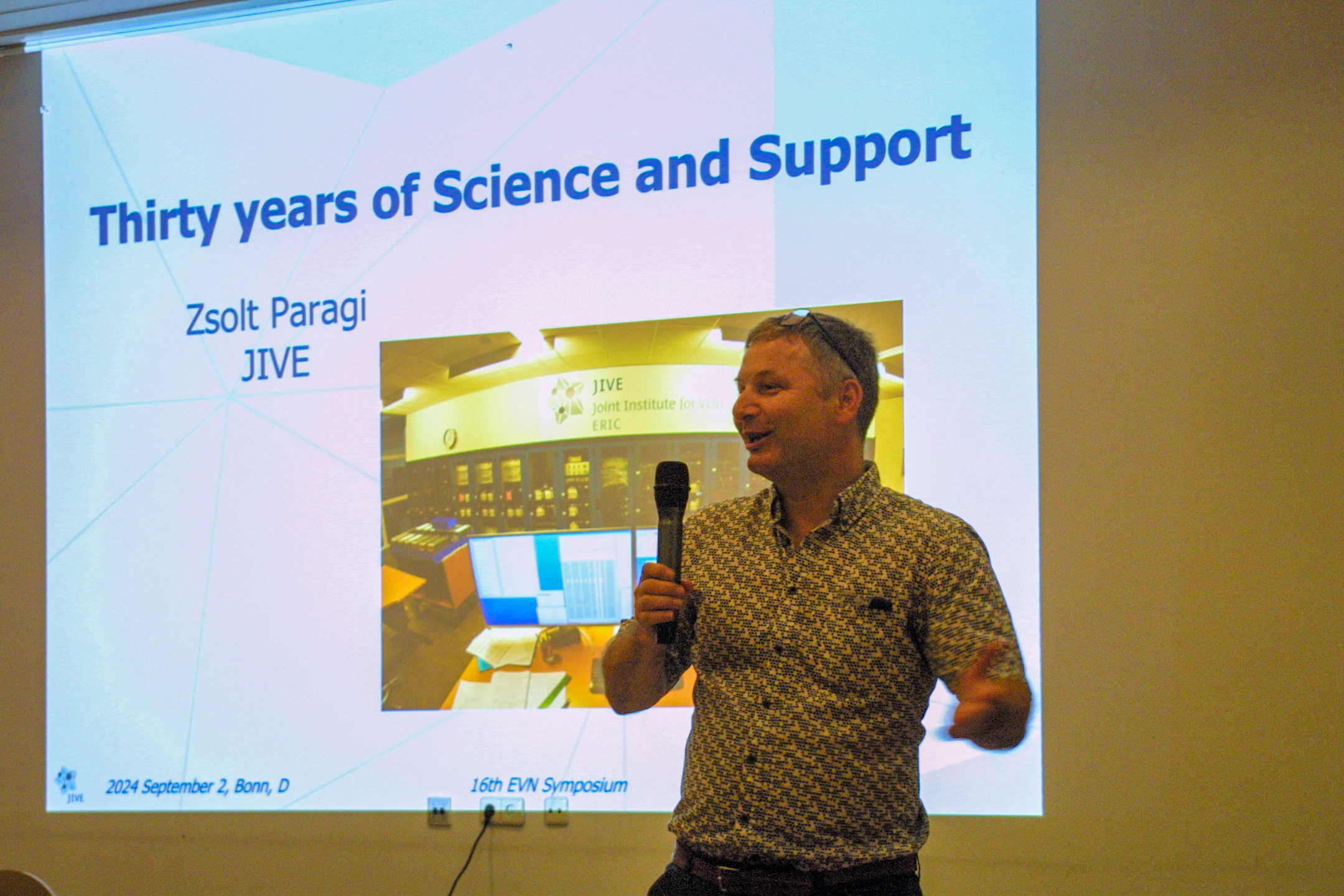
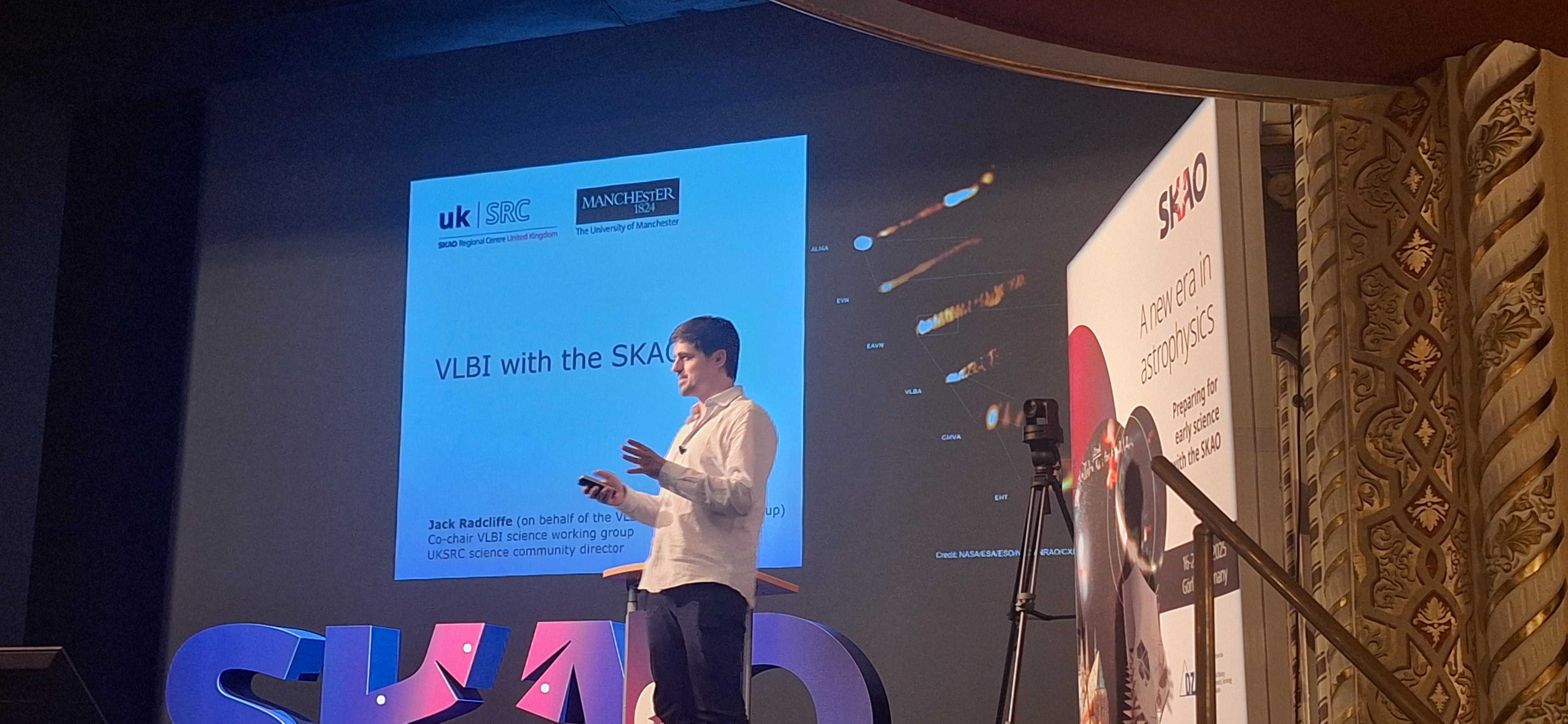
Zsolt Paragi at the 16th EVN Symposium (2024). © A. Nikonov Jack Radcliffe at the SKAO Science Meeting 2025. © Rob Beswick
Q1. You both have multidimensional careers and hold responsible positions. Could you briefly introduce yourselves and tell our readers a bit about your professional journey and connection to the EVN?
Zsolt Paragi: I first came to Dwingeloo in 1996/97 for a student exchange program, where I spent a year studying VLBI. Since 2002, I have formally been at JIVE in various roles: initially supporting EVN operations, then helping with the transition to real-time e-VLBI, later becoming Head of User Support, and, since 2021, serving as EVN PC Chair.
My scientific interests include high-redshift active galactic nuclei (especially dual/binary AGN) and various types of transients. I have conducted EVN/e-VLBI research on classical transients and coordinated the initial developments to detect short transients at JIVE, which led to the localisation of fast radio bursts on milliarcsecond scales with the EVN. I initiated the efforts in the EVN community to follow up electromagnetic counterparts to gravitational wave events, which led to the VLBI detection of the afterglow from the first known neutron star–neutron star merger. I continue to support multimessenger astronomy, serving as a main coordinator within the EC-funded ACME project.
Jack Radcliffe: I started in 2014 with my first project in astronomy, which involved wide-field VLBI with the EVN — a task that is challenging for students, advisers, VLBI arrays, and correlators alike! This project spanned Manchester, Groningen, and Dwingeloo (via ASTRON). Since then, I have continued my advisers’ tradition of pushing the correlator towards larger VLBI surveys, fostering ongoing collaborations with JIVE and other VLBI-focused institutions.
My research has mainly focused on AGN surveys, star formation–AGN feedback, and more technically oriented areas such as VLBI pipelines, commensal surveys, and new calibration algorithms. I have also explored variability, FRBs, and protoplanetary disks. I was based at the University of Pretoria, where I helped develop the VLBI research group with Roger Deane and John McKean; it is now well established. I have participated in various VLBI training schools across Europe, both creating and delivering tutorials through ERIS and JIVE/CASA VLBI schools. Additionally, I have contributed to the African VLBI initiative through Development in Africa with Radio Astronomy, where I coordinate the VLBI data reduction segment.
Most recently, I have been involved in integrating the EVN with the SKA Observatory and African partners as co-chair of the VLBI science working group. In parallel, I have been exploring geodetic (including VLBI) capabilities across Africa through the GGOS-Africa project.
Q2. Zsolt, looking back, what do you consider the main changes from your time as Chair — both in the way the PC operates and in how the EVN has evolved as a network?
ZP: The EVN PC plays a role in developing the EVN policies, but ultimately, major decisions are made at the Consortium Board of Directors (CBD) level. However, we have introduced several important changes to the workings of the EVN PC, which were necessary to handle the increasing number of proposals in recent years. Examples of EVN policies where we made a significant impact include kick-starting the EVN-Lite network to support out-of-session transient science (although there is still work to be done), securing Sardinia Radio Telescope support Target of Opportunity requests, and incorporating the uGMRT and MeerKAT in the network.
The most recent changes are declaring 4 Gbps recording as the default mode of operations for continuum projects at 6 cm and shorter wavelengths starting in 2026, and kick-starting the SWEEPS project. The latter is a joint project between the University of Pretoria and JIVE to explore the possibilities of making multi–centre processing standard in the EVN, transforming it into a wide-field of view VLBI instrument, also paving the way for SKA-VLBI.
These are developments that the whole programme committee —and I personally—am very proud of. Overall, it has been an exciting period for me serving as Chair of the EVN PC. With my term now concluded, I am pleased to have passed this role to a well-known expert in our field, who is the ideal person to lead us into the future.
Q3. Jack, as you take over, how do you plan to build on what has been achieved in the past term? What do you see as the main priorities and challenges for the PC in the coming years?
JR: It’s quite a challenge to follow the remarkable work Zsolt has done over the past few years, to be honest! I believe one of the main priorities for the EVN CBD, alongside the PC and TOG, will be to ensure the EVN meets expectations. This might include making the EVN more dynamic so it can deliver more efficiently across a broader range of scientific cases, work that has already begun. Additionally, given all the recent successes of the EVN, I really want to focus on encouraging non-VLBI astronomers to submit more proposals by lowering the barriers to VLBI something JIVE has already begun doing effectively.
Internally, I hope to modernise the EVN PC, especially since we do not currently adopt all modern standards, such as double-blind review processes and external expert assessments. This seems an ideal time, particularly with upcoming changes to the EVN and the proposal process adopting the Polaris observing tool, which the EVN will use in 2026. Looking further ahead, the PC will also need to ensure that new arrays, such as the SKAO, can be incorporated seamlessly into our reviewing processes. Finally, on a personal note, I would like to change our unusual way of scoring proposals.
Q4. The EVN continues to evolve both technically and organisationally. Jack, how do you see the Programme Committee adapting to this changing landscape — from new technologies to increasing observation demand and the SKA becoming fully operational?
JR: Given the increasing capabilities of the EVN, whether it is tri-band receivers, new observing modes, or new telescopes, the PC will need to adapt to ensure we continue delivering the required service to our users. This might mean increasing our headcount to meet rising demand or diversifying our expertise should a new field emerge, as FRBs did in the last decade. Additionally, the PC must be flexible enough to incorporate new instruments/arrays, such as SKAO, smoothly, as has been achieved with global VLBI observations using the VLBA and the KVN.
Q5. Finally, for both of you: What is the deeper vision that this role serves — the one that might not always be visible in the day-to-day operations?
ZP: The EVN and JIVE are fully committed to open skies policies, dedicated to maintaining a FAIR and open EVN archive, and fully support and train all users regardless of their level of experience in the radio domain. By its very nature, VLBI builds on partnerships between different organisations across Europe and beyond. Personally, I would like to see this global collaboration develop further with seamless integration of next-generation facilities like the SKA and ngVLA.
JR: While we are there to observe, review, and recommend which proposals align with the EVN, the broad perspective we gain on VLBI and the wider astronomical landscape is crucial to ensuring the EVN can adapt to user needs. Personally, given the worsening geopolitical situation, VLBI offers an opportunity for science to be conducted across continents, and I believe it is our responsibility, along with the entire astronomical community, to remind the world of what can be achieved together on a global scale.