

IRAS15250+3609: minor merger revealed as an OH MegaMaser
Antneh Tegegne
The 1667/1665 MHz OH emission shows an unusual two-component 1667 MHz profile covering a velocity range from -250 kms-1 below to 400 kms-1 above the assumed systemic velocity of the host galaxy showing a systematic velocity gradient from west to east across the nuclear region.
The PV velocity signature and the OH emission profile indicate that the masering material belongs to a dwarf galaxy falling nearly radially (from the west) into the nuclear region of face-on IRAS 15250+3609. Three velocity ranges can be identified in this minor merger: a high velocity range for infalling material that is still mostly unperturbed, an intermediate velocity range where infalling material first interacts with the host galaxy, and a negative velocity region where material has already crashed into the host.
The OH emission scenario places the molecular material of the infalling section of the dwarf galaxy in front of the AGN/starburst nucleus where starburst-related FIR radiation provides the excitation and allows line-of-sight amplification of the nuclear continuum.
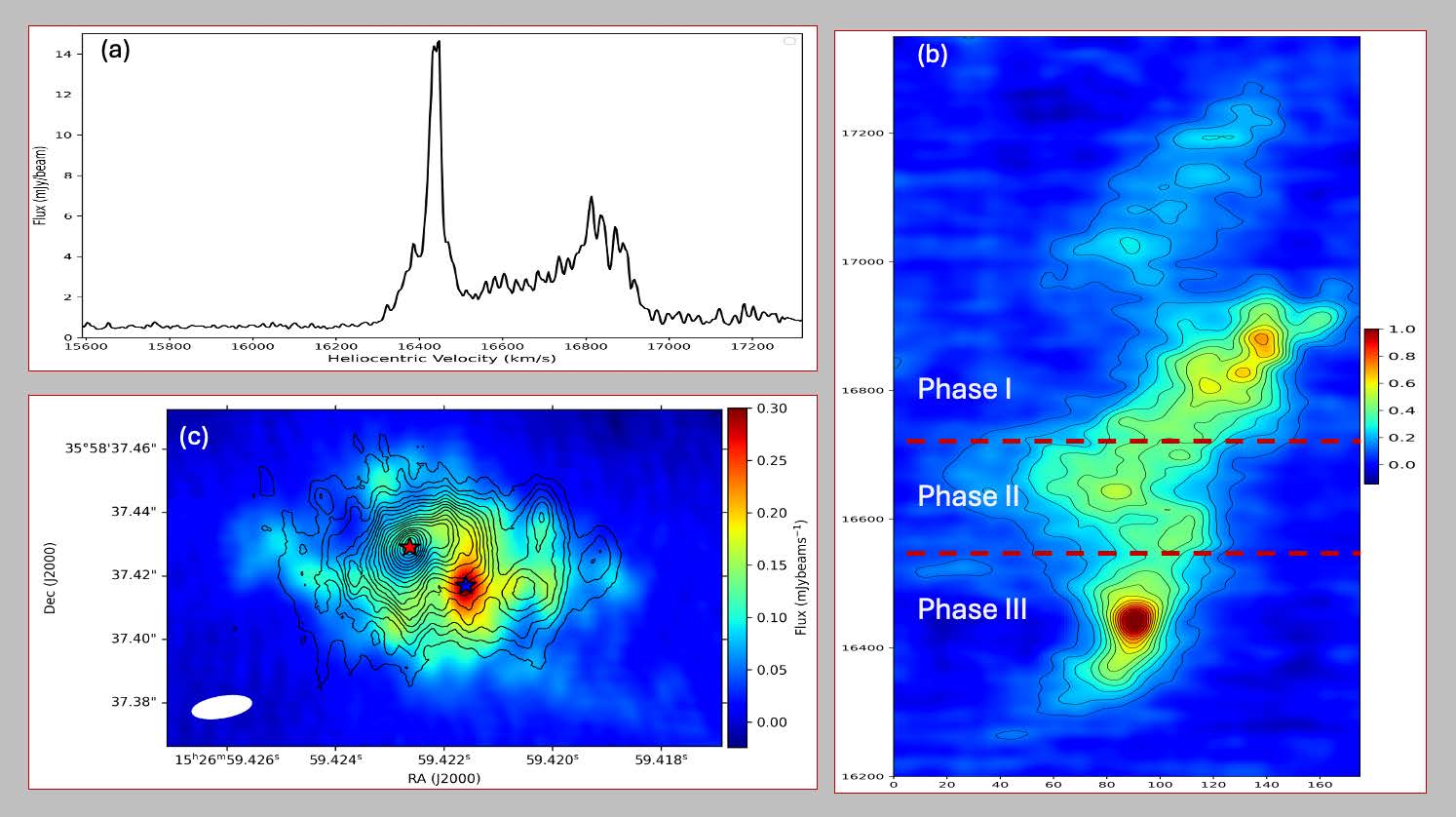
Figure: (a) The two-component OH spectrum of IRAS 15250+3609 dominated by 1667 MHz emission. (b) An RA position-velocity diagram of the OH emission in the dwarf galaxy material located in front of the AGN/starburst nucleus. The dwarf galaxy is nearly radially falling into the host galaxy from the West and the three stages of infall are identified. Weak 1665 MHz emission is only identified in the upper velocity range. (c) The OH emission (contours) superposed on the radio continuum (colour). The red star indentifies the location of the AGN in host galaxy IRAS 15250+3609 and the blue star identifies the location of the peak emission, which lies beyond the AGN.
Link to the paper:
Monthly Notices of the Royal Astronomical Society, Volume 543, Issue 1, pp. 841-850, 10 pp.
Contact:
Willem Baan, Xinjiang Astronomical Observatory, ASTRON. Email: baan@astron.nl